Truth
At first glance, the young woman crossing the street seems to be wearing a joke. But the line on her shirt carries more than humor: “I always arrive a little late, like the truth.”
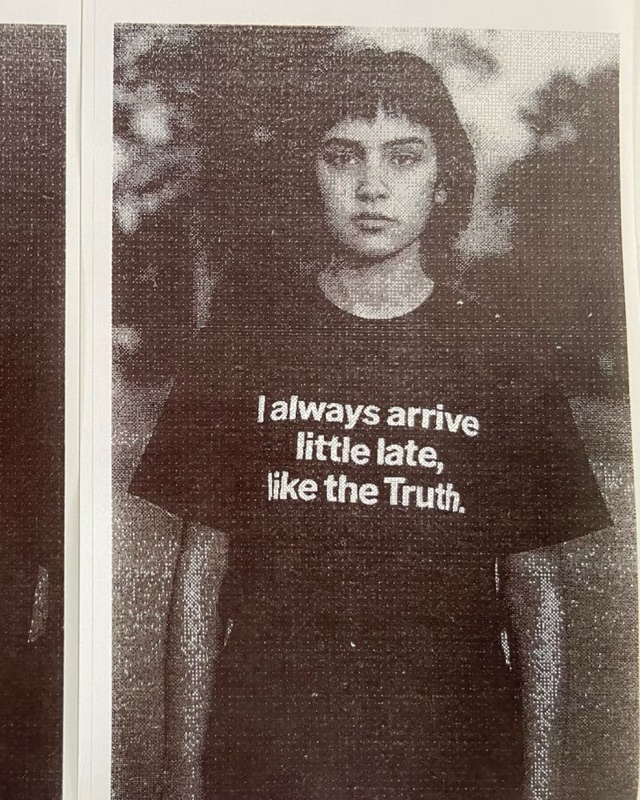
That feels familiar. Clarity often comes after the moment has passed — after the argument, after the wound, after the chance to speak cleanly has gone. We laugh because the line is true in a way that stings.
Truth is closer to weather: shifting, gathering, breaking, clearing. What we call truth often changes as memory reshapes our experiences. A trauma revisited years later may not match the raw fact of what happened years ago— but that does not make it false. It only means we are now able to recognise what the event felt like from the inside.
That is where the old problem of perspective begins. In Rashomon, truth is not one thing sitting at the centre, waiting to be found. It breaks into pieces, each reflecting a different need, fear, or desperation. Nietzsche suspected as much: there is no view from nowhere. Every truth is seen from somewhere — through a body, a history, a particular set of losses. We are never outside the feeling we are trying to describe.
Contradictory truths, then, do not cancel each other out so much as coexist. One person stands in the rain and feels refreshed; another feels trapped. Neither is lying.
They are merely living from different emotional climates. What changes over time is not truth itself, but our capacity to see more of it. We grow into new angles. We notice different edges of the same stone.
That is why the woman’s shirt works so well as a line for the street — and for life. It speaks to how late understanding often arrives, but also to how patient truth can be. It does not always come with certainty. It can come back in fragments, in revised memory, in a quieter and more honest conversation with ourselves.
Truth isn’t a final verdict. It’s a dialogue that keeps adjusting to the shape of our human lives.


