Private Mannequins
The late afternoon street moves like a current, full of errands, speed, and half-light. And then, against all that motion, the old woman stops the flow. She stands bent slightly before a shop window, looking at the mannequins with a focus so fixed it almost feels sacred. This is not the casual glance of a shopper. It is something more exact, more private. Her eyes rest on the synthetic body in front of her with the seriousness of someone studying a truth no one else can see.
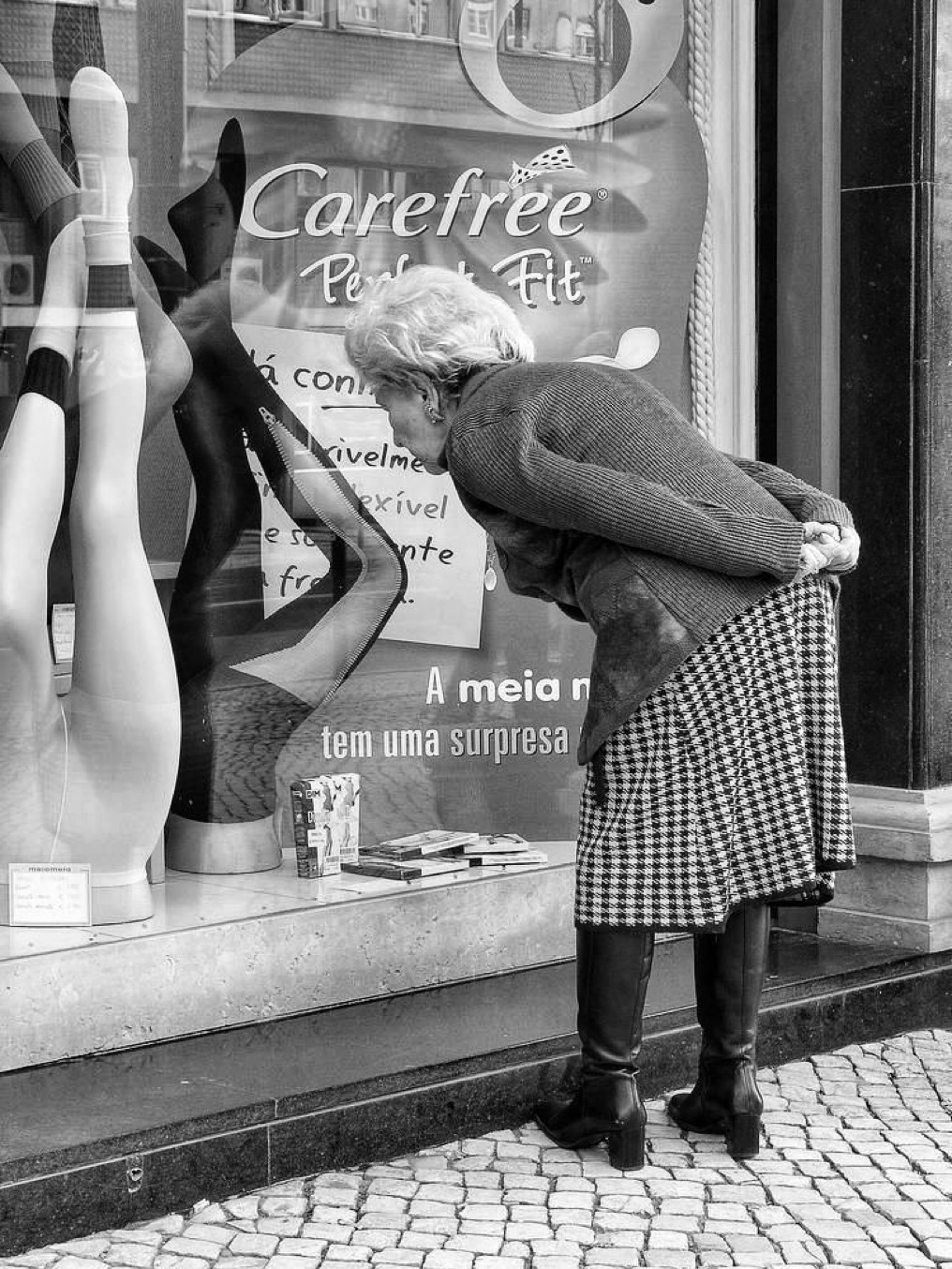
That is what makes the moment so compelling: the woman becomes unreadable even as she is being watched. To the people passing by, she is just another figure on the street, a pause in the rush of the city. But from the outside, she feels like a sealed room. It is tempting to invent a story for her — to imagine she is measuring the clothes against an older version of her own body, or thinking about a life she once lived differently. But that urge to explain is really our own discomfort with not knowing. We want to turn strangers into stories because mystery unsettles us.
Walter Benjamin understood the city as a place of fragments, where private life keeps slipping into public view and then disappearing again. This scene carries that same feeling. The woman’s stillness has the tension of a film still, as if something important has just happened or is about to happen, but we have arrived in the middle with no context. Her attention may be on the mannequin, or it may be somewhere else entirely — in memory, in thought, in a place unreachable from the pavement where she stands.
That is what makes street life so haunting. Every person carries a world we cannot enter. The city is full of closed books, and most of what we see are only covers, gestures, surfaces. The woman’s vigil before the window reminds us of that distance. She remains opaque, just like the mannequins she studies. And that opacity is not a lack. It is the part of human presence that refuses to be solved.


